Turn a skill into an offer people actually buy
How to move from "I can do this" to a defined offer with a clear outcome, price and buyer — the first rung of a solo business.
There is a particular kind of week that ends with a strange feeling: you were busy, you were useful, you helped people, and yet nothing became easier. No asset was built. No new client came in by themselves. If the work had stopped for a month, almost nothing would have changed.
That is the signature of selling a skill rather than an offer. The distinction sounds pedantic, but it is the difference between work that compounds and work that is consumed.
What a skill is not
A skill is a capability: you can write copy, edit video, design a logo, run paid ads. It is real, and it is valuable. But on its own it is not something a buyer can purchase, because a buyer cannot tell:
- What result they will get
- How long it will take
- What it costs
- Whether they are the right person for it
“I do marketing” is a skill. “I help B2B SaaS teams land their first 10 customers through a 6-week outbound campaign, for a fixed fee, with a written report at the end” is an offer.
The second sentence is longer, and that is the point. An offer removes the guesswork from both sides.
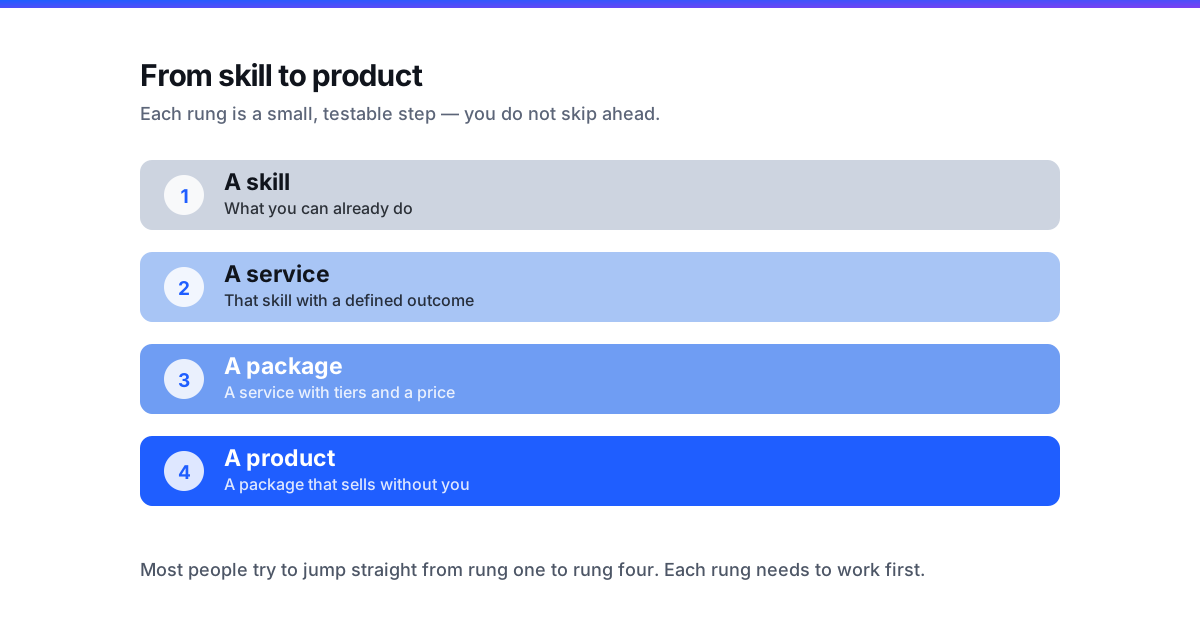
The four parts of a real offer
Every offer that sells cleanly contains the same four ingredients. If one is missing, buyers stall — usually politely, and usually by not replying.
1. Who it is for. Not “small businesses” but a group you can recognise. The narrower this sounds, the better it works, because you can then describe their situation without them having to translate it.
2. The outcome. Not a list of activities (“strategy, content, reporting”) but the change the buyer ends up with. What is different on the other side?
3. The scope. What is included, what is not, and what happens if they want more. Scope is where projects go wrong, and it is the part most people are vaguest about.
4. The price and the next step. A number, and a single clear action. “£2,400, reply with ‘yes’ and I will send the contract” beats “rates on request” every time.
A quick test
Write your offer in one sentence. If it contains the words "and other related services", or ends with "as needed", it is not finished. A finished offer can be refused, and that is what makes it sellable.
Start narrower than feels comfortable
The instinct when choosing who your offer is for is to widen — to include more people, more needs, more industries. This feels safe and it is usually the opposite of safe, because a broad offer forces the buyer to do the positioning work for you.
A useful test: could a stranger tell, after reading your offer once, whether it is for them? If they would need to ask a clarifying question, the offer is too broad.

Narrowing is not a permanent constraint. It is a starting position that makes your marketing cheap, because you can be specific in a way that only works when you are narrow.
Name the trigger
Buyers do not buy because a service exists. They buy when something happens that makes the problem urgent — a launch, a churn spike, a funding round, a new hire, a deadline.
Getting specific about the trigger changes where you look for clients and what you say when you find them. “Marketing help for B2B SaaS” is a category. “Getting your first 10 customers after a Series A, when the founding team has no time to do outbound” is a moment you can build a whole business around.
Write it down before you sell it
You do not need a website to have an offer. You need one page that states the four parts, and then you need to use it in conversation.
A practical sequence for your first week:
- Write three candidate offers, each for a different narrow buyer.
- Say each one out loud to someone who is not in your field. Watch for the moment their eyes glaze over — that is where the offer is too abstract.
- Pick the one that produced the most follow-up questions. Genuine curiosity is a better signal than polite agreement.
- Put it on a single page, with a price and a booking link.
That is enough to test. Everything else — the site, the funnel, the email sequence — comes after you have said the sentence out loud to a real person and had them respond to it.
What this looks like in practice
A common pattern is that a freelancer with a good offer in a narrow market still struggles for the first two months, then gets busy and stops struggling. That is normal, and it is worth naming, because the most common mistake is treating a slow start as a signal to change the offer rather than to keep talking to people.
Change the offer when people understand it and still say no. Keep it when people do not understand it. Those are two different problems with two different fixes, and confusing them is how good offers get replaced with vague ones.
A note on the tools we use
The offer itself needs no tooling at all. The documents around it do, and we keep that list short: a proposal template, a scope document, and an intake form. The free Solo Business Toolkit has all three in a form you can copy today.
The short version
A skill is what you can do. An offer is what a buyer gets. Write one sentence that names who it is for, the outcome, the scope and the price, then test it in conversation before you build anything around it. Stay narrower than feels comfortable — and keep the offer still until people understand it, even if they say no.
Want a shortcut?
The free Solo Business Toolkit walks you through the same setup in order — offer, pricing, first client, first product — with the checklists we use ourselves.
Get the free toolkitAffiliate link — we may earn a commission at no extra cost to you.
Keep reading
A weekly operating system for a one-person business
The goal is not to work more hours. It is to stop deciding what to do every morning, so the business runs on a rhythm instead of on panic.
Read article →
Marketing on a budget: pick one channel and own it
Most solo businesses do not fail at marketing because they lack tactics. They fail because they spread a small budget across five channels.
Read article →
Build a digital product that sells while you sleep
The most reliable way to build a digital product is to sell a rough version before you build it. Here is the sequence that avoids a year of wasted work.
Read article →