A weekly operating system for a one-person business
A repeatable weekly rhythm, a small tool stack and a short list of templates that stop a solo business from becoming admin forever.
Most solo businesses are not short of work. They are short of a system for deciding what the work is. Every Monday starts with a blank page, and every blank page produces a day spent on the most comfortable task rather than the most valuable one.
The fix is not productivity technique. It is a rhythm: a small set of named activities, each attached to a fixed slot, repeated every week until it stops requiring a decision.
Why a rhythm beats a list
A task list says what needs doing. A rhythm says when. The difference matters more than it sounds, because a list leaves every prioritisation decision open, and a list of open decisions is exhausting in a way that a busy day is not.
A rhythm answers three questions automatically:
- What happens on Monday? Something is already decided.
- What happens if I miss a day? The next slot picks it up. Nothing falls apart.
- What is not allowed to happen? The unfilled slots are protected.
That last one is the important one. A rhythm creates permission to say no, because the week’s shape is already fixed.
The weekly shape
Here is a rhythm that works for a solo service business. Adapt the labels, keep the structure.
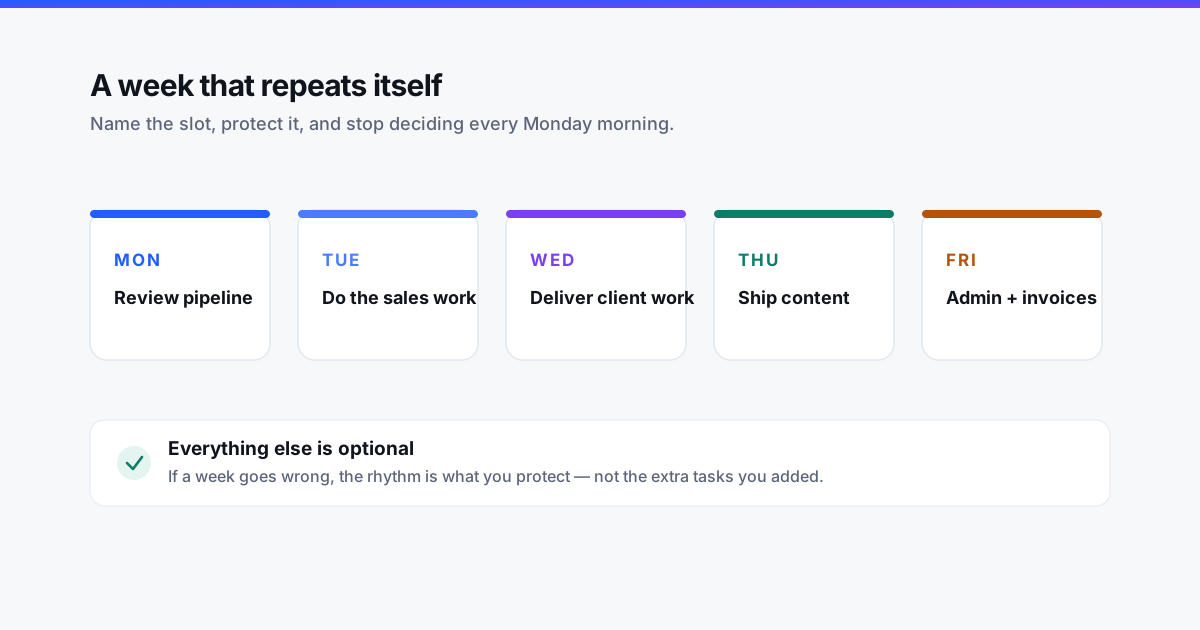
Monday — pipeline review. Thirty minutes. What is in the pipeline, what is stuck, what needs a nudge. This is the most valuable half-hour of the week and the one most often skipped, because it feels like planning rather than doing.
Tuesday — sales and outreach. All new conversations in one block, while your attention is fresh. Batching this matters more than you would expect: switching between “selling” and “delivering” has a cost that feels like procrastination.
Wednesday — delivery. Protected, uninterrupted, no admin, no inbox. This is the day that pays for the business.
Thursday — content and marketing. One piece, or one meaningful update. If you are also selling a product, this is when you build the asset that sells it later.
Friday — admin, invoicing, and review. Invoices go out. The week gets a fifteen-minute review: what worked, what did not, what changes next week.
The whole thing fits in a normal week. The point is not the shape itself — it is that the shape is decided once and then repeated.
The daily rule
One rule keeps the rhythm intact: one daily priority, decided the previous evening.
Not a task list. One thing that, if it happens, means the day was a success. Everything else is maintenance. Write it in a notebook, a note, a pinned message — anywhere that is not a tool you have to open.
The reason this works: the biggest time cost in a solo business is not doing the work, it is deciding what the work is. One decision, made once a day, removes dozens.
The tool stack that is enough
A small business needs few tools. The failure mode is not too few tools — it is adding a new one whenever a small annoyance appears, until the setup and maintenance of tools takes more time than the work.
Five categories cover almost everything:
| Need | What to look for | Keep it to one of |
|---|---|---|
| Money | Invoicing, payment collection, basic bookkeeping | One all-in-one account |
| Work | Where the files, briefs and deliverables live | One place with search |
| Calendar | Meetings, deadlines, focus blocks | One calendar, one source of truth |
| Communication | Email, plus a form for new enquiries | One inbox you actually read |
| Your website | Pages, email capture, payment links | One site you own |
The rule for adding anything: wait a month. If the annoyance still exists, replace something rather than adding. A five-tool stack that you understand beats a fifteen-tool stack you are still learning.
Where we have a bias is the website and the funnel. A single page that explains your offer and takes payment removes an enormous amount of back-and-forth from every enquiry — you can send people there and let it work while you sleep. The free Solo Business Toolkit walks through setting up that page and the checkout that goes with it.
The templates that matter
You do not need to design anything. You need to write it once and reuse it. The four documents that remove the most recurring friction:
- Intake form — the questions you would otherwise ask in every email. Collect it once and stop being the bottleneck.
- Scope document — what is included, what is not, what happens if the client wants more. Written once, adapted per project.
- Proposal template — the same structure every time, so writing a proposal takes twenty minutes instead of an hour.
- Invoice and chase template — including what to send when an invoice goes unpaid. The fact that it exists makes it less painful to send.
The test for a good system
If a task still needs a decision every time, it is not a system yet. It is a habit you have not written down. Write it down once and it becomes a slot.
The review that keeps it honest
Once a month, sit down for thirty minutes and ask three questions:
- What did I actually spend my time on, versus what I planned?
- Which part of the business generated money, and which was just activity?
- What am I doing repeatedly that a template, a tool or a decision could remove?
The third question is the useful one. Every hour of recurring work you remove goes back into selling or delivering — and those are the only two activities that grow a business.
The short version
Decide the week’s shape once and repeat it: review, sell, deliver, create, administer. Protect the delivery day, and protect the slots that are not on it. One daily priority, written the night before. Keep the tool stack to about five, and wait a month before adding anything. Write your recurring documents once. Then look at the month and remove one recurring task.
Want a shortcut?
The free Solo Business Toolkit walks you through the same setup in order — offer, pricing, first client, first product — with the checklists we use ourselves.
Get the free toolkitAffiliate link — we may earn a commission at no extra cost to you.
Keep reading
Marketing on a budget: pick one channel and own it
Most solo businesses do not fail at marketing because they lack tactics. They fail because they spread a small budget across five channels.
Read article →
Build a digital product that sells while you sleep
The most reliable way to build a digital product is to sell a rough version before you build it. Here is the sequence that avoids a year of wasted work.
Read article →
Getting your first five clients without cold-calling strangers
You do not need a personal brand or a following to get started. You need five people who already know what you can do.
Read article →