Marketing on a budget: pick one channel and own it
Why a single focused channel beats five half-efforts, and how to pick the right one and run it on almost no money.
Marketing advice for small businesses has a strange pattern: every piece of it is individually reasonable, and following all of it at once guarantees you produce almost nothing that works.
Blog here. Post there. Newsletter. TikTok. Podcasts. SEO. A YouTube channel. Five half efforts produce five mediocre results and no compounding, because none of them gets enough attention to teach you what works.
The math of focus
Marketing channels have a fixed cost per unit of attention, and a learning period before they produce anything. Doing five at once splits your limited hours five ways and starts five learning periods at once, so all five finish late.
The alternative is unglamorous and works: pick one, run it for long enough to learn from it, then add a second.
How to pick the channel
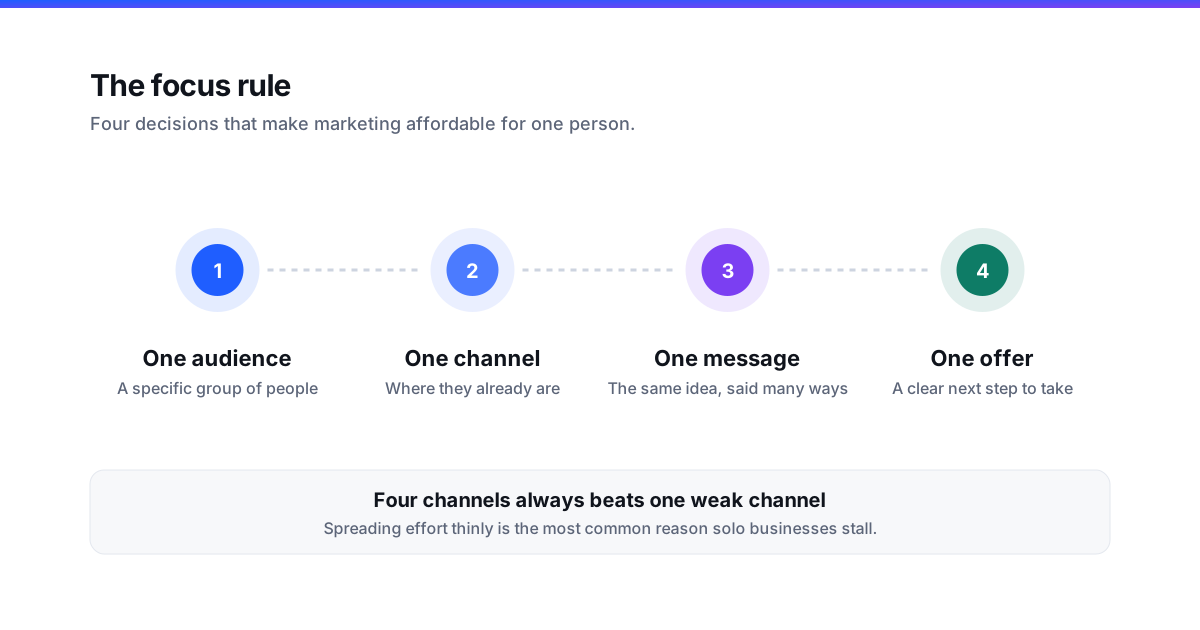
The right channel is not the biggest one. It is the one where your intended buyers already spend time, and where you can produce something you would actually keep making.
Work through these questions:
Where does your buyer already talk about this problem? Search the platform they use. If your buyers are in Facebook groups, LinkedIn will not reach them.
What can you produce consistently for three months? A daily short video is a full-time job. Two long articles a month is not. Choose the volume you would actually sustain on a bad week.
What can you be genuinely useful about? The channel is a delivery mechanism; the content is the value. If you only have tips for one narrow thing, that is what you should publish.
Where can you also sell? The channel has to connect to somewhere you can take money — a page, a form, a checkout, a call booking.
The two-channel test
A common setup that works: one channel for reaching new people, and email for the people you have already reached. Everything you publish eventually ends up in a list you own. That is the whole marketing engine.
One message, said many ways
People do not need more content. They need to understand what you do, repeatedly, in different ways, until it clicks.
The most effective content strategy for a small business is narrow: one core idea, ten angles on it.
Take a single sentence — “I help small manufacturers win back repeat customers through simple email automation” — and express it as:
- A story about a client with that exact problem
- A checklist for diagnosing whether they have it
- A teardown of something that gets it wrong
- An opinion about a change in the industry
- A behind-the-scenes walkthrough of your process
- A case study (when you have one)
- A myth you want to correct
- A question that makes people think
- A comparison
- A failure you made and what it taught you
Ten pieces of content, one idea, one channel. Each piece reaches a slightly different slice of the same audience and they reinforce each other.
Run it long enough to learn
The most common reason people switch channels is that they have not yet seen results. But results on a new channel lag, and switching resets the clock every time.
A workable commitment:
- Pick a channel and a volume — for example, two posts a week.
- Commit to 12 weeks — long enough that you have 24 data points.
- Judge on one metric only — replies, saves, or profile visits, not follower count.
- Change the execution, not the channel — if posts are not landing, try a different angle before a different platform.
Twelve weeks feels long. It is the minimum for a channel to produce an honest signal, and switching at week six is the same mistake as starting a new channel at week one.
What to spend
Almost nothing, and that is a genuine advantage. A focused marketing budget for a solo business can be a few pounds a month:
- Time — the main cost, and the only one that cannot be bought
- One tool — a scheduling tool, a design template, a writing assistant. One is enough.
- Optional reach — a small paid boost on the single post that already performed well in organic. Boosting a post that already works is cheap and effective; boosting a weak one just buys you a weak result more expensively.
Your buyer is not reading your post — they are watching you work. A single well-made video in the right place outperforms a month of text posts, because it demonstrates the expertise instead of claiming it.

The rule we use
If a post did not work in organic, do not pay to promote it. If a post did work, promoting it is the cheapest growth available to a business with no ad budget.
The compounding bit
Every channel you use should feed something you own. A follower is rented land. An email address is yours.
So the full loop looks like:
- Publish in one channel where your buyers are.
- Every piece points to one place — a page, a checklist, a newsletter.
- People who want more give you their email address.
- You send to them directly, for free, forever.
Step 4 is where the compounding starts, and it is the step most people skip because it does not look like marketing any more. It looks like sending email — but it is the only audience you will ever have without paying for it.
The short version
Pick one channel where your buyers already are, and one message you can repeat for twelve weeks. Produce ten angles on that single idea. Judge it on one metric, and when results are thin, change the execution rather than the platform. Make sure everything you publish leads somewhere that collects an email address — because the audience you own is the only one that does not need to be re-bought every month.
Want a shortcut?
The free Solo Business Toolkit walks you through the same setup in order — offer, pricing, first client, first product — with the checklists we use ourselves.
Get the free toolkitAffiliate link — we may earn a commission at no extra cost to you.
Keep reading
A weekly operating system for a one-person business
The goal is not to work more hours. It is to stop deciding what to do every morning, so the business runs on a rhythm instead of on panic.
Read article →
Build a digital product that sells while you sleep
The most reliable way to build a digital product is to sell a rough version before you build it. Here is the sequence that avoids a year of wasted work.
Read article →
Getting your first five clients without cold-calling strangers
You do not need a personal brand or a following to get started. You need five people who already know what you can do.
Read article →