Build a digital product that sells while you sleep
A realistic path from freelancing to a digital product: validate the idea with a paid pilot, then build only what buyers asked for.

The dream is specific: you record a course, write a guide, build a template, and then the sales roll in while you sleep. It is a genuinely good business model — no marginal cost per sale, no hours per order, and revenue that does not require your presence.
It is also the most common way solo operators spend a year of their life on something nobody wanted.
The difference between the two outcomes is almost never quality. It is sequence.
Why the dream usually does not work
The failure pattern is consistent. Someone has a genuinely useful idea, spends four months building it properly, launches it to a mailing list of forty people, and gets silence. Then they conclude the market was wrong, when the actual problem was that the market never saw it until it was finished.
The expensive part is not the failure. It is the four months of building before anyone had a chance to say no.
Validate with a paid pilot
A paid pilot is the smallest possible version of the product, sold to a real person for real money, before you build anything.
It looks like this:
- One specific problem, for one specific buyer, solved in one specific format.
- Sold at a real price — not free, not “name your price”.
- Delivered manually, in a week or two, with no automation and no polish.

That is the whole method. Everything else is detail.
Why the price has to be real
A free pilot tells you what people think is interesting. A paid pilot tells you what people will actually do. The gap between those two is where most failed launches live.
The number of people who need to say yes varies by how expensive your normal work is, but the logic is simple: if you are not sure, sell to ten. Three yeses at a real price is a strong signal. Three “interested”s and zero sales is a clear no.
Choose the format that is cheapest to produce
For a first product, the format matters less than the speed of production. Rank them by effort:
- A written guide or template — usually the fastest, and often the most useful
- A short workshop, live — cheap to build, but time-bound
- A recorded course — expensive to build, expensive to update
- A subscription or community — never start here, whatever influencers say
Most people reach for a course first because it feels like the biggest product. It is usually the wrong first product: it takes longest, it is hardest to update, and it is hardest to sell cold.
If you sell a guide successfully and want to go further, a course becomes much easier to build — because now you know exactly which parts people need, and you already have the audience.
Write the product before you build it
The cheapest way to find out whether a product works is to write the whole thing as text before recording or designing anything. A document is fast to write, fast to change, and readable by a buyer in a weekend.
That text then becomes:
- The outline for a course
- The structure of a template pack
- The content of a mini e-book
- The script for a live workshop
Write it first. You will find within two hours whether you have enough to say.
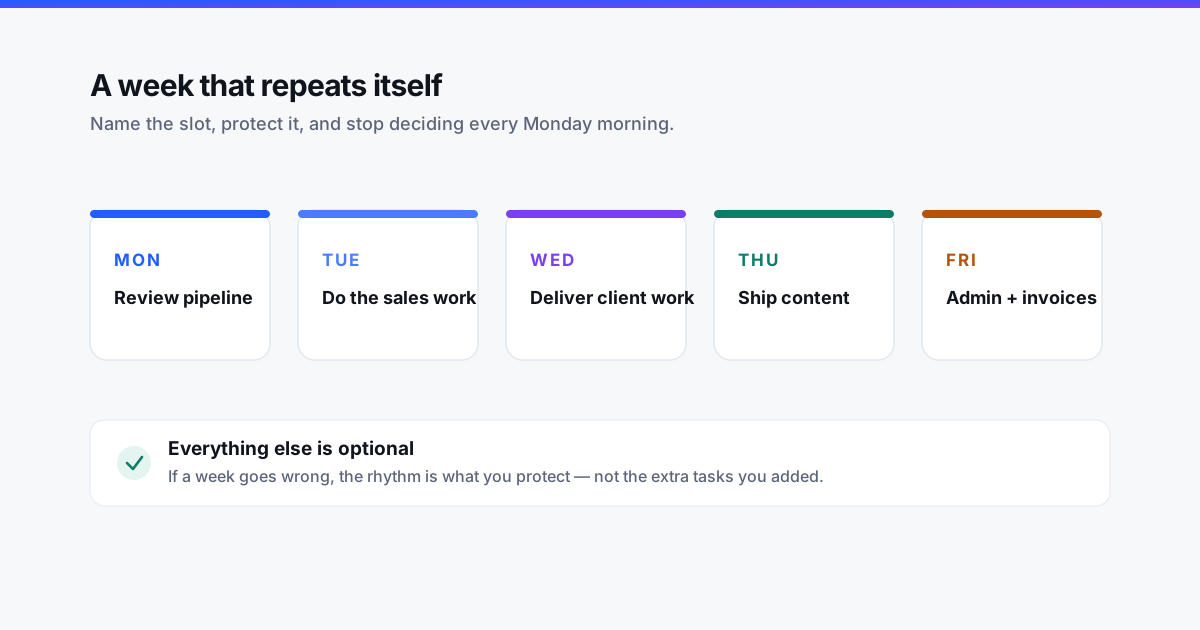
Price it so the decision is easy
Most first products are priced far too low, because the fear of “charging too much” is stronger than the desire to build a business. A price that is too low does two bad things: it signals low value, and it attracts buyers who want the cheapest option and are the hardest to serve.
A reasonable starting point: price the pilot at roughly what the outcome is worth to the buyer, discounted for the fact that it is an early version. If the outcome is worth £500 and you charge £25, you have told the market the outcome is worth £25.
For the launch, a two-tier structure works well and is easy to implement:
- A low tier — the product plus something small. Gets you sales, testimonials and people in the audience.
- A high tier — the product plus direct access, a call, or a bonus module. Gets you revenue and proof that people will pay more.
What “sells while you sleep” actually means
It is worth being precise, because the phrase sets an unrealistic expectation. A product does not sell itself. What it does is sell without your active involvement in each transaction — no scoping call, no custom work, no delivery, no invoice.
That requires three things, and none of them are “record a course”:
- A clear problem that buyers already recognise
- A page that explains it — what it is, who it is for, what it costs, what happens after they buy
- A repeatable way to reach people — an email list, a newsletter, a channel where people already follow you
Get those three right and the product does most of the work while you sleep. Skip them and no amount of polish will help.
A realistic timeline
- Weeks 1–2 — Choose the problem. Interview five people who have it. Write the problem in their own words back to them and check you have it right.
- Weeks 3–4 — Write the product as text. Set the price. Sell the pilot to ten people.
- Weeks 5–6 — Deliver the pilot manually. Ask each buyer what was missing and what they would pay more for.
- Weeks 7–9 — Rebuild the product around what buyers actually used. Write the sales page. Set up the checkout and delivery.
- Week 10 — Launch to the list, with the pilot buyers as testimonials.
Ten weeks from idea to a launched product, without ever building something nobody wanted.
The short version
Sell a rough version before you build a real one, and charge real money for it. Write the product as plain text first — it is the cheapest way to find out what is worth including. Start with a guide or template rather than a course. Then build the three things that make a product sell without you: a clear problem, a clear page, and a repeatable way to reach buyers.
Want a shortcut?
The free Solo Business Toolkit walks you through the same setup in order — offer, pricing, first client, first product — with the checklists we use ourselves.
Get the free toolkitAffiliate link — we may earn a commission at no extra cost to you.
Keep reading
A weekly operating system for a one-person business
The goal is not to work more hours. It is to stop deciding what to do every morning, so the business runs on a rhythm instead of on panic.
Read article →
Marketing on a budget: pick one channel and own it
Most solo businesses do not fail at marketing because they lack tactics. They fail because they spread a small budget across five channels.
Read article →
Getting your first five clients without cold-calling strangers
You do not need a personal brand or a following to get started. You need five people who already know what you can do.
Read article →