How to price your freelance work without guessing
A practical method for setting freelance rates — cost floors, value-based pricing and a simple script for raising your price with existing clients.

Pricing is the one number in a freelance business that is entirely yours to choose, and it is also the one most people choose by accident. If you have ever ended a project feeling underpaid — or talked yourself down after quoting — the fix is usually not “charge more”. It is having a method that produces a number before the client asks for one.
Why hourly billing punishes you
Hourly pricing sounds safe: you get paid for the time you spend. But it quietly punishes the two things a solo business needs most — getting faster, and getting better.
If a client sends you a brief you can execute in four hours instead of ten, hourly billing takes money away from you. If you have learned to write landing pages that convert, your rate does not change to reflect it. So people drift to a hybrid: they quote a project fee but set it by mentally multiplying hours by a number they once chose years ago.
That number is usually anchored to something unhelpful — a colleague’s rate, a forum thread from five years ago, or a vague sense of what feels “reasonable.”
Step 1: Find your cost floor
Before any market discussion, work out the number below which the work is not worth doing. This is not an hourly rate. It is a project floor.
Add up the costs that only exist because you are running a business:
- Software and tools — your editor, hosting, invoicing, scheduling, file storage.
- Insurance, tax and accounting — set aside a percentage of revenue for tax from day one, and add professional indemnity cover if your field needs it.
- Your salary — what you need to draw per month to cover your life, divided by the number of billable days you realistically work.
- A buffer — 10–20% for the month when the pipeline goes quiet.
The 20-minute version
Take your required monthly personal income, add your business costs, divide by the number of projects you can realistically deliver in a month, then add your buffer. That is your floor. Any quote below it is not a discount — it is a decision to work for less than the work costs.
Write this number down and treat it as non-negotiable. Not as a negotiating position — as a filter. If a project will not clear the floor, the answer is no, or the scope changes.
Step 2: Price against the value, not the effort
With a floor established, the second question is what the outcome is worth to the client. This is harder to answer than hours, because the effort is visible and the value is not.
Value pricing asks a different set of questions:
- What does this outcome save the client, or what does it make possible?
- What would it cost them not to fix this for another year?
- What does the same result cost them elsewhere — an agency, a hire, a competitor?
- How many customers, leads or dollars does the outcome touch?
You do not need a precise answer. You need a range, and you need to be able to say it out loud in one sentence.
“This onboarding rework saves your support team roughly 15 hours a month. At your current cost per ticket, that’s the number I’d base the project fee on.”
Step 3: Pick your rung deliberately
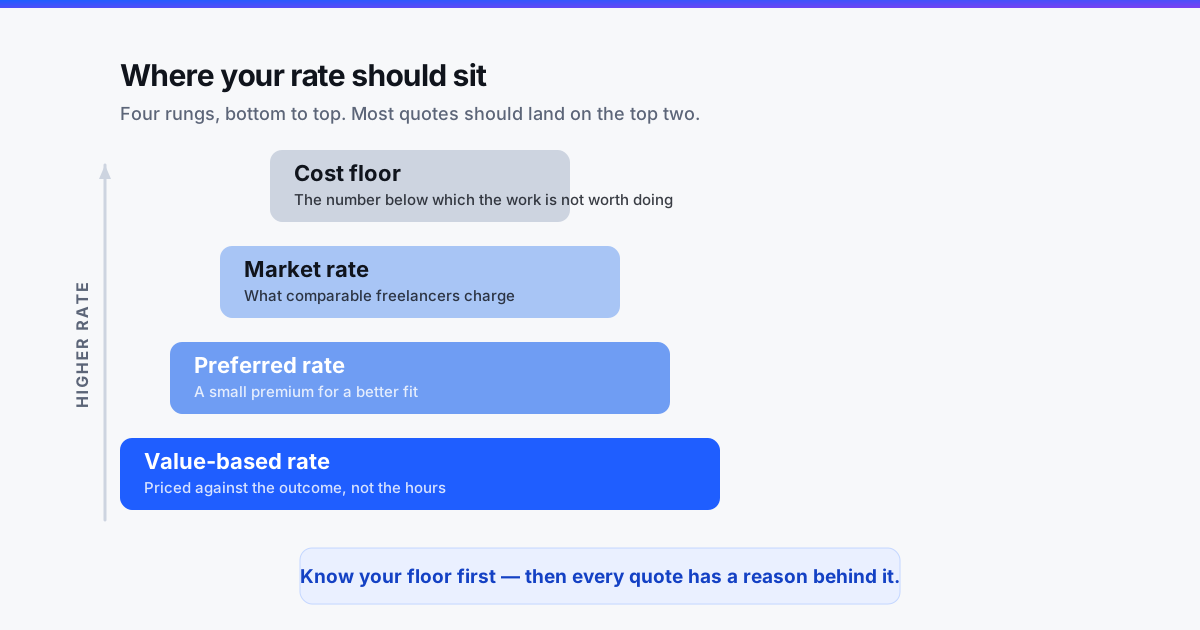
Most freelance work sits on one of four rungs, and clients on the same rung expect similar numbers. Being on the wrong rung for the wrong client is how you end up either undercharging or losing every pitch.
| Rung | What the client expects | The trap |
|---|---|---|
| Cost floor | Cheapest possible, replaceable | You earn the least and get the most scope changes |
| Market rate | Comparable to other freelancers | You are competing on a metric the client can shop |
| Preferred rate | Slightly above market, better fit | Needs a reason beyond price |
| Value rate | Priced against the outcome | Requires you to explain the outcome, not the hours |
The move most freelancers need is not raising every price. It is moving one tier of clients up — usually the ones who are ready for it but have never been asked.
Step 4: Set the project fee
Once you have a floor and a value range, convert one into a number:
- Take the midpoint of your value range.
- Subtract the hours you expect to spend, valued at a sensible internal rate.
- That difference is your margin on the project.
- Sanity-check the result against the market rung for your field.
If step 3 produces a number that feels unreasonable, the problem is usually that the value argument is weak or the scope is vague — not that you miscalculated.
Step 5: Raise your price with existing clients
Existing clients are the cheapest place to test a higher price, because they already trust you and already know the quality of the work.
A simple structure that works:
“For the work we have done so far I have been charging £X. Given the results, I am moving my rate to £Y from the next project. If you would like to lock in the current rate for the next [period], I can do that.”
This gives them a choice, a deadline, and a reason. It works often enough that the occasional “no” costs you nothing — that client was going to be your most price-sensitive one anyway.
What to do when the client pushes back
Price pushback is information, not negotiation failure. There are only a few useful responses:
- Ask what they expected. A large gap usually means a scope misunderstanding, which is worth finding out about regardless of who was right.
- Restate the outcome. You may have quoted on effort rather than effect in the first place.
- Reduce scope, keep the rate. Cutting the deliverable is usually better for your business than cutting the price.
- Offer a smaller engagement. A paid diagnostic, a one-off review, or a short sprint gives them a lower-risk way to start and gives you a way to earn the bigger project later.
What you should not do is apologise for your number or invent a discount you had not planned. Discounting before you have quoted is the most expensive habit in freelancing, because the client learns that the first number is not the real one.
A note on the tools we use
None of this needs software. A spreadsheet and a written rationale per client is enough. Where a tool genuinely helps is in the boring parts — invoices, contracts, scheduling and chasing payment. We keep that stack deliberately small, and the free Solo Business Toolkit covers the document set we start every client project with: intake form, scope template, proposal and invoice.
The short version
Work out your cost floor before you look at the market. Anchor your fee to a value range, not to hours. Know which rung the client sits on. Set the number before the call, and treat a pushback as a question about scope rather than a request to discount.
Want a shortcut?
The free Solo Business Toolkit walks you through the same setup in order — offer, pricing, first client, first product — with the checklists we use ourselves.
Get the free toolkitAffiliate link — we may earn a commission at no extra cost to you.
Keep reading

Getting your first five clients without cold-calling strangers
You do not need a personal brand or a following to get started. You need five people who already know what you can do.
Read article →
A weekly operating system for a one-person business
The goal is not to work more hours. It is to stop deciding what to do every morning, so the business runs on a rhythm instead of on panic.
Read article →
Marketing on a budget: pick one channel and own it
Most solo businesses do not fail at marketing because they lack tactics. They fail because they spread a small budget across five channels.
Read article →